
 USA
USA  Canada
  Brazil
  Germany
  France
  Italy
Italy  Switzerland
  Sweden
  Great Britain
  Norway
  Russia
  South Africa
  Japan
Japan  New Zealand
  Australia
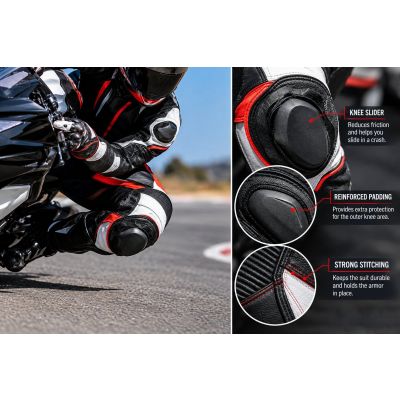
When you're leaning hard into a corner on a sportbike or pushing your limits on a track, your body is exposed to serious sliding risk. Motorcycle knee sliders are protective components built into racing suits and high-performance jackets to reduce abrasion damage during a crash or slide. Understanding how they work and why they matter can help you make a smarter choice when buying protective motorcycle gear.
Knee sliders serve one primary purpose: they protect your knees and lower thigh area from intense friction and abrasion if you slide across asphalt or road surface during a crash. Instead of your leather or textile gear taking the full force of the slide, the sliders contact the ground first, allowing your body to move across the surface with reduced skin damage. For track-day riders, sportbike riders, and road racers, this feature can be the difference between a manageable injury and severe road rash.
Quick Answer
Motorcycle knee sliders are reinforced protective pads attached to the outer knee area of racing suits and jackets. They're designed to contact the ground during aggressive cornering or crashes, reducing abrasion to your legs and supporting impact protection. Sliders are especially important for track riders, racers, and sportbike riders who lean at extreme angles or ride at higher speeds where sliding risk is elevated.
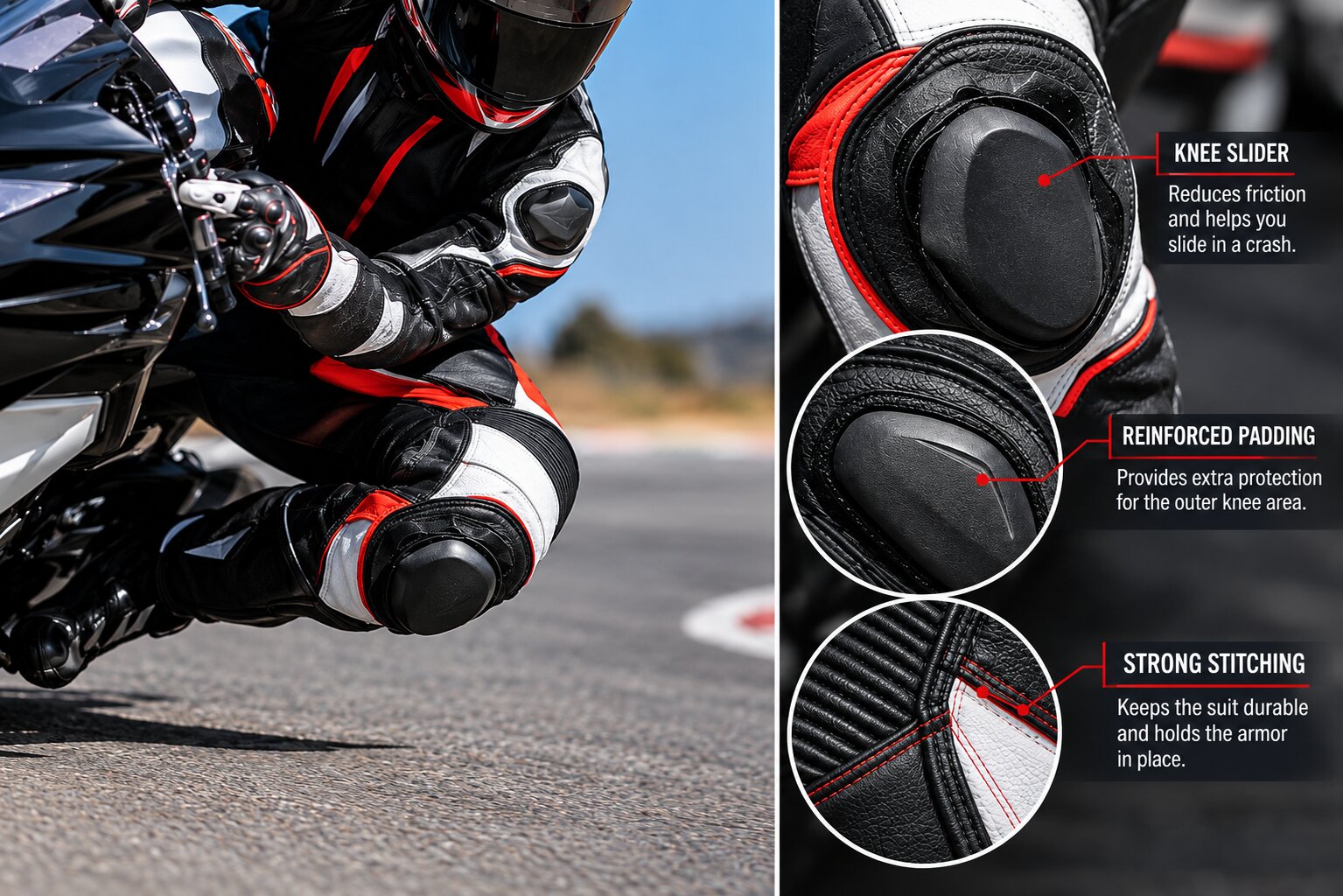
Table of Contents
- What Knee Sliders Actually Do
- Why Motorcycle Knee Sliders Matter for Your Safety
- How Knee Sliders Protect You During a Crash
- Slider Placement and Coverage
- Choosing Gear with Effective Knee Sliders
- Common Mistakes Riders Make with Protective Gear
- Frequently Asked Questions
What Knee Sliders Actually Do
Knee sliders are reinforced pads made from durable materials like polyurethane, nylon, or specialized composite compounds. They're sewn or bonded to the outer knee area of racing suits, leather jackets, and protective pants. During a slide, the slider contacts the pavement first, creating a friction barrier between your skin and the road surface.
The key benefit is directional control and abrasion reduction. When you're leaning hard in a corner and your bike goes down, your body slides forward and sideways across the ground. The slider glides across the asphalt, dissipating energy and allowing your leg to move with the slide rather than being caught or dragged. This reduces the intensity of skin abrasion and helps protect the underlying tissue underneath your protective gear.
Sliders also help distribute impact force across a wider area. Instead of a concentrated point of contact, the slider spreads the sliding friction across its surface, which can reduce the severity of road rash and support the protection provided by your leather or textile shell.
Why Motorcycle Knee Sliders Matter for Your Safety
Track-day riders and racers understand that aggressive cornering and high-speed riding create sliding scenarios that street riders may never experience. When you're leaning 50, 60, or even 70 degrees into a corner, your knees are at serious risk if the bike slides out from under you.
For street and city riders, knee sliders matter less frequently but still provide important backup protection. A low-speed crash, a sudden loss of traction, or an emergency slide can happen to any rider. Gear with knee sliders gives you an extra layer of abrasion protection without adding significant weight or bulk to your suit or jacket.
Riders who spend time on both track and street benefit most from suits with quality knee sliders. The investment in this feature pays off by reducing injury severity if a slide does occur. For sportbike riders who ride aggressively on public roads, knee sliders are a practical safety choice.
How Knee Sliders Protect You During a Crash
When a motorcycle crashes or slides, your body's momentum carries you forward and across the pavement. Your knees, hips, elbows, and shoulders are vulnerable to intense friction burns. Knee sliders work by making contact with the ground surface first, before your skin or underlying protective armor is fully exposed to the abrasion force.
Here's what happens in a typical slide scenario:
Your body makes initial contact with the pavement. The knee slider touches down and begins to glide across the road surface. As you slide, the slider material absorbs friction and allows your leg to move smoothly rather than catching or tumbling. Your leather or textile shell, reinforced with stitching and seam strength, protects the areas behind the slider. The combination of the slider's friction reduction and your gear's abrasion resistance limits the depth and severity of road rash.
Sliders are especially effective at lower and moderate speeds, where abrasion is the primary injury risk. At very high speeds, impact force increases significantly, and sliders alone cannot prevent serious injury. This is why high-quality racing suits combine knee sliders with CE-certified armor, reinforced leather, and strategic stitching to address both abrasion and impact risks.
It's important to understand that sliders reduce abrasion risk but do not eliminate it entirely. A severe slide will still cause injury; the slider simply helps reduce the severity compared to gear without sliders.
Slider Placement and Coverage
Knee sliders are positioned on the outer knee area, where your knee makes contact with the ground during aggressive leaning or a slide. Quality racing suits place sliders strategically to cover the most vulnerable part of your knee joint while maintaining comfort and mobility during normal riding.
Some high-performance suits also include hip sliders or thigh sliders to extend abrasion protection to the hip and upper leg area. These additional sliders provide broader coverage if your slide angle brings your hip or outer thigh into contact with the pavement.
Slider size and thickness vary by suit design and intended riding use. Track-focused racing suits typically feature larger, thicker sliders for maximum abrasion protection during aggressive cornering. Street-focused protective jackets may use smaller, thinner sliders to reduce weight and maintain comfort for everyday wear.
When evaluating a racing suit or protective jacket, check the slider placement carefully. Sliders should be positioned where your knees naturally contact the ground during leaning, not too high or too low. Poor placement reduces effectiveness and may create uncomfortable pressure points during riding.
Choosing Gear with Effective Knee Sliders
When shopping for a racing suit or protective jacket, look for these quality indicators in the knee slider design:
Material durability: High-quality sliders use reinforced polyurethane, nylon, or specialized composite materials that resist wear and maintain effectiveness over multiple slides. Check the product details or ask the manufacturer about slider material specifications.
Secure attachment: Sliders should be sewn or bonded firmly to the suit shell, not loose or peeling. Poor attachment reduces protection and creates a safety risk if the slider separates during a slide.
Appropriate thickness: Sliders should be thick enough to provide abrasion protection but not so thick that they create uncomfortable bulk or restrict leg movement during normal riding.
Proper fit: Your suit must fit correctly for sliders to be effective. If your suit is too loose, your knee may not align with the slider during a lean or slide. If it's too tight, the slider may not contact the ground properly. Custom-sized racing suits ensure that sliders align with your body position and provide maximum protection.
Riders who want to compare related Leather Collection protective gear can explore
for options built around fit, protection, and riding use.Combined armor coverage: Knee sliders work best when paired with CE-certified knee armor underneath. The armor absorbs impact force while the slider reduces abrasion. Look for suits that clearly identify armor placement and certification levels.
Common Mistakes Riders Make with Protective Gear
Many riders buy protective gear with good sliders but then wear it incorrectly or fail to maintain it properly, reducing its effectiveness.
Wearing ill-fitting gear: A suit that's too loose or too tight won't protect you effectively. Sliders won't align with your knees, and armor may shift during a crash. Always choose a suit that fits snugly without restricting movement. If you're between sizes, custom sizing is worth the investment for track riders and serious sportbike riders.
Ignoring armor underneath: Sliders reduce abrasion, but they don't absorb impact. Riders sometimes focus only on sliders and forget to check that their suit has proper CE-certified armor in the knee, elbow, shoulder, and hip areas. Both features matter.
Failing to inspect gear after a crash: Even if you slide at low speed, your sliders and armor should be inspected for damage. Crushed or compromised armor may need replacement. Damaged sliders may need repair or replacement to maintain protection in a future slide.
Choosing sliders over fit and construction: A suit with impressive sliders but poor overall construction, weak seams, or thin leather won't protect you as well as a well-built suit with moderate sliders. Slider quality matters, but so do abrasion resistance, seam strength, and overall gear quality.
Frequently Asked Questions
Do all motorcycle racing suits have knee sliders?
Not all protective jackets and pants have knee sliders, but most quality racing suits do. Entry-level or budget-focused gear may skip sliders to reduce cost. If you're shopping for track-day gear or sportbike protective wear, look specifically for suits with sliders. For casual street riding, sliders are less critical but still valuable for crash protection.
Can you replace knee sliders if they wear out?
Some sliders can be replaced by a leather repair specialist, but replacement availability and cost vary by suit brand and design. Some suits have sliders that are permanently bonded and cannot be replaced. Before buying, ask the manufacturer or retailer whether sliders are replaceable. This can affect the long-term value of your investment.
Do knee sliders work at high speeds?
Knee sliders are most effective at moderate speeds where abrasion is the primary injury risk. At very high speeds, impact force increases dramatically, and sliders alone cannot prevent serious injury. High-quality racing suits combine sliders with reinforced leather, impact armor, and advanced construction to address both abrasion and impact risks at any speed.
How do knee sliders affect comfort during normal riding?
Quality sliders are designed to be minimally intrusive during normal riding. They add slight weight and bulk to the knee area but should not create pressure points or restrict leg movement. If sliders feel uncomfortable during normal riding, your suit may not fit correctly, or the slider design may not suit your body position. Always test gear before committing to a purchase.
Are motorcycle knee sliders required for track days?
Most track-day organizations and racing events do not mandate knee sliders, but they are strongly recommended. Check your local track or event rules for specific gear requirements. Many experienced track riders consider sliders essential for safety and confidence during aggressive cornering.
Can you add knee sliders to an existing suit?
Some leather shops and gear specialists can add sliders to existing suits, but quality and durability depend on the repair shop's expertise and materials. Adding sliders after purchase is typically more expensive than buying a suit with sliders already installed. If you're considering adding sliders, get a quote from a reputable leather repair specialist before deciding.
What's the difference between knee sliders and knee armor?
Knee sliders are protective pads on the outer surface of your gear that reduce abrasion during a slide. Knee armor is impact-protection padding installed inside or under your suit to absorb force from blunt trauma. Both are important. Sliders protect against friction; armor protects against impact. Quality racing suits include both.
Conclusion
Motorcycle knee sliders are a practical, proven safety feature that helps reduce abrasion injury during crashes and aggressive slides. They're especially valuable for track-day riders, racers, and sportbike riders who face elevated sliding risk. Understanding how sliders work—and pairing them with quality leather construction, proper fit, and CE-certified armor—helps you choose protective gear that supports your riding style and safety goals.
Sliders alone don't make you crash-proof, but they're part of a complete protective system that includes abrasion-resistant materials, reinforced stitching, impact armor, and proper fit. When shopping for a racing suit or protective jacket, evaluate sliders alongside overall gear quality, construction, and how well the suit fits your body and riding position.
For riders comparing a real gear example,
shows how construction, fit, and protective features can work together.The next step is to try on suits in person, check slider placement and construction quality, and confirm that your gear fits snugly without restricting movement. Whether you're preparing for your first track day or upgrading to a more advanced racing suit, investing in gear with quality motorcycle knee sliders is a smart choice for your long-term safety and confidence on the bike.